top of page


Ebb & Flow
A Maritime Cultural History of Bridgehampton
On View:
March 8, 2024 - Present
Open Hours:
Wednesdays - Saturdays, 11am to 3pm
Location:
The Nathaniel Rogers House, 2539 Mtk Hwy, Bridgehampton
Bridgehampton’s long and storied history is inextricably tied to the ocean, lakes, ponds and estuaries that surround it. From whaling and fishing to lifesaving and recreational hobbies, all of the people of Bridgehampton have woven the sea and the waters around them into the tapestry of their community. The water provides food, entertainment and feeds the economy. It has truly shaped its identity and impacted the direction the community has taken over the centuries.
EBB & FLOW is conceptualized as a rotating exhibition space that explores the many stories tied to Bridgehampton and its maritime cultural history. Below you can see a snapshot of what we have on display.

Ever since the first mariners set off to explore the seas, new, exotic, and sometimes strange, items have been brought back as souvenirs, trophies and relics of voyages to distant lands.
The watermen and whalers of our area were no different. They would traverse the globe, whaling, trading, and exploring new locales. With each new journey they would return with exciting mementos from their travels. We have culled our archive and are exhibiting a small selection of items that locals had returned to Bridgehampton with from The Farthest Corners of the world.


The actual manufacturer of this instrument, Charles Lincoln belonged to the previous generation of London instrument makers, trading from 1765 to 1804 in various locations on Leadenhall Street. Leadenhall Street in London was a popular area for optical instrument makers. From 1772 onwards he was at 62 Leadenhall Street, with an address starting with “Sir Isaac Newton’s Head” – presumably this was the sign over the door.
His Father Thomas Lincoln (under whom Charles trained), was himself a renowned maker who served as the Master of The Spectacle Maker’s Company from 1746 – 1747 and his death coincides with Charles’s early trading period, suggesting that he took over an already respected business. He succeeded to his Father's position in The Spectacle Maker’s Company from 1787 – 1790 and was known to have had numerous apprentices notably Charles Silberrad and William Cox, the latter being turned over to him from John Cuff.
Excepting his large achievements during his lifetime, Lincoln’s trading life is as yet only lightly documented. His instruments and those of his apprentices however, continue to speak very well for his abilities as an instrument maker.


Situated in the South pacific in present day Micronesia, The Gilbert Islands were visited by whalers frequently in the 19th century. Sailors mapped the area extensively and interacted with the local people.
The indigenous Kiribati peoples' lives were tied to the sea. And as with many Micronesian and Polynesian cultures, sharks played an important cultural role for the I-Kiribati. Sharks are involved in the origin mythology of the islands and they played a major part in religious initiation ceremonies.
Using part of the great creatures in a weapon would imbue it with some of the shark’s strength. We can see too that sharks have continued to play an important role in Kiribati. By identifying teeth used in Gilbert Islands weaponry, researchers from Columbia University and the Field Museum were able to prove that at least two of the sharks once used for these weapons were no longer endemic to the region.
It is important to note that based upon our research, the museum believes that the objects in our collection hail from the Gilbert Islands, however we have not yet fully confirmed their point of origin.


Shark fishing was only done by experts. The larger size of the prey required fishermen to travel farther away from shore and employ methods including remarkable deep-sea hooks. When the teeth had been removed from the sharks, weapons were fashioned using available materials. The weapons were used ceremonially as well as to resolve disputes and in battle.
The swords are made from seasoned wood of the coconut palm with cutting edges made from sharks teeth attached with fine fibrous cords. Most of these swords were destroyed by the maritime visitors to the islands.
The weapons resembled broadswords with a serrated edge created with many shark teeth. The duels were performed mostly for the purpose of settling disputes and maintaining honor.

Kiribati has a history of contrived and ritualized duels. The armor was made of thickly woven sennit, a kind of coconut fiber. The duelists wore helmets made of blowfish remains. The helmets were resilient and, due to the structure of blowfish, covered with many points. Combat on the Gilbert Islands tended to inflict many injuries, but relatively few fatalities. One of the reasons for this is the immensely effective armor used by Kiribati warriors.
War in Kiribati’s islands took place for any of the usual reasons. As sides faced off, combat usually began with projectiles—mostly stones, but in this case shark-barbed spears were also used. When the distance between the two waring parties had been closed, the shark tooth swords and clubs were used.
These swords were not only threatening in appearance but were extremely effective at inflicting both shallow lacerations and blunt force trauma. Ceremonial duels between the champions of feuding villages were often settled using the shark-toothed weapons.
We find people using feathers to make different types of garments on every continent except Antarctica. They have a universal appeal, and humans are mesmerized and drawn to their colors and textures. In Asia, across Europe, throughout Polynesia, the America’s and in Africa. These garments symbolize different things and serve various purposes from culture to culture.
During the 1800s feather pelerines became highly fashionable in England after native Hawaiian royalty visited the country. A pelerine is a woman's cape of a variety of materials with pointed ends at the center front, popular in the 19th century. Upper-class English ladies would have contemporary feather pelerines made from exotic feathers.


Feather Pelerine (Collar or Cape), 19th Century
cotton and feathers from various birds (peacocks, guinea fowl, among others)36 x 26 in. ( 91.4 x 66 cm) approximately
According to museum records, this item was a gifted to a Methodist minister by a Shinnecock whaler who acquired it in the Philippines.
(included in the present exhibition)
The two pelerines in the Museum’s collection come from two different sources. It is difficult to say with absolute certainty where these feathered pelerines were made and acquired. Similar pelerines can be found in museums around the world. Despite their commonality, very little is known about their manufacture and scholars and curators have debated their origins. Some have speculated that they may have been made by Native Americans in the Great Lakes regions while others have argued that they are English made but Polynesian inspired, crafted in the South Pacific, Asia, or India.
Despite the uncertainty and controversy, what we can say is that these two examples make beautiful additions to the museum’s permanent collection. Providing inspiration through their beauty and craftsmanship and serving as the catalyst for discourse.


Left: illustration from the 1850s of a woman in a pellerine
Right: Feather Pelerine (Collar or Cape), 19th Century
cotton and feathers from various birds (peacocks, guinea fowl, among others)33 x 23 in. (83.2 x 58.4 cm) approximately
According to museum records, this item is purported to have been brought back from a whaling trip by the donor’s ancestor, Captain William Wallace Hildreth.
(included in the present exhibition)

Scrimshaw is the term used for engravings and carvings done in bone or ivory. Sperm Whale teeth were the main material used by many whalers in this artform. Whalers would produce a mixture of art and everyday household items from the teeth and bones of their catch.
The Bridgehampton museum offers a small selection these items from our archive.






Claus Hoie, from "The Log of the Whaler Helena", watercolor on paper
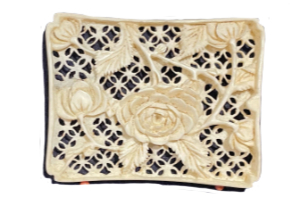
Belt or Shoe Buckle, c. 19th century. This item represents the level of intricacy that could be achieved by artisans carving in whale bone. (included in the present exhibition)
Ivory Pocket Calendar and Diary, 19th Century. Sperm Whale Tooth Pocket-sized calendar that consists of eight small pages of whale ivory, all hinged at one end with a single rivet. Each page measures 2½ x 1⅝ in The pages are stamped at the top edge with a different day of the week from Monday through Saturday. The inner pages are protected with a thicker ivory outer page cover at the front and back. (included in the present exhibition)
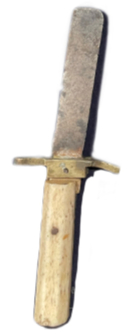
Whalebone Knife Handle, c. 19th century. This object represents how whale bone elements were integrated into everyday objects. (included in the present exhibition)
Whalebone Butter Spreader, c. 19th century. This object illustrates how whale bone and ivory was fashioned into items intended for everyday use. The materials and byproducts of whaling permeated nearly every facet of every day life in our area, even in "Miss Isabel's" home. (included in the present exhibition)
Pie Crimper, c. 1850s Made from whalebone, this was donated by Lulu H. Raynor; belonged to her grandfather, David J. Swain. (included in the present exhibition)

Cribbage, a card game where players keep score with pegs on a board, is believed to have been invented in the 17th century. It became a favorite of sailors and was especially popular on whaling ships. Sailors would make their own boards out of carved whalebone, animal teeth or tusks. Thus, as the sailors travelled around the globe, cribbage as was introduced to people and cultures all around the world.
Cribbage remained popular into the 19th century, immortalized in Charles Dickens' tale, the Old Curiosity Shop. The game was very popular with sailors as it only required a deck of cards, a cribbage board, and two players.


19th Century Cribbage Game, 1800s
Rosewood, mahogany, and other woods (inlaid) 2x4¾x3½ in. (5.1 x 12.1 x 8.9 cm) closed
This object is an incomplete cribbage set presumed to be English from the late 19th century however, it could possibly be dated earlier. The box is inlaid has several varieties of wood, including Rosewood, Mahogany and (possibly) Pearwood. Includes four hand made dice and two small spikes for playing the game.
(included in the present exhibition)

The sea was a bountiful resource that fed life but it was also treacherous and could turn on the brave souls that sailed upon her waves and take it as well. Numerous vessels have fallen victim to storms and the dangers that lay just beneath the surface of the cold grey briny waters of the Atlantic Ocean off of the coast of Long Island.


One such ship that met a disastrous end off our coast was The Circassian. This tragedy had far reaching implications that effected not only the sailors and owners of the vessel, but also the Indigenous Shinnecock people of Southampton.
Setting sail on November 6, 1876, The Circassian was an iron-hulled vessel sailing from its home port of Liverpool for New York laden with an industrial cargo which included bricks, chemicals such as soda ash, 471 bales of old rags and 281 bags of hide pieces.
She had already had an eventful life, being built in 1856 as a steamer but the engine had been stripped out and she was now used full sail. Over the years she had been a passenger and cargo ship working the Irish Sea, then a blockade-runner during the American Civil War, then captured and used as a Union troop ship and by this time was owned by DeWolfe and Co. of Liverpool as a cargo workhorse.


1862 Harper's Weekly engraving of Captured Blockade Runners
Bridgehampton- Life Saving Station and crew preparing life lines, c. 1900
Harper's Weekly Engraving of Circassian Wreck, 1876

However, insurance companies began to make plans to salvage the cargo and release the ship by using a wrecking crew if necessary. The Circassian’s captain insisted that his men would assist with salvage operations but not all were keen after what they had gone through and over half left for New York. He was left with fourteen crew plus the stowaway.
The remaining Circassian crew and the wrecking crew reached out to the local Shinnecock Native American community for assistance as they had a reputation for volunteering in similar situations in the past. By December 24th a third of the cargo had been removed but on the 29th a greater storm rolled in. All the men helping with salvage were ordered to stay on board; it is rumored at gunpoint.
The force of the storm created a breach in the hull and the ship began to take on water. The crew sent up a distress signal and the Life Saving Service from Mecox Station again responded. It was the worst storm in living memory and the rescuers could not get near the ship. The Circassian began to break up and disintegrated around 4.30am on December 30th.
There were only four survivors: three from the Circassian’s original crew and one of the wrecking crew. Twenty-eight had perished including all ten Shinnecock volunteers. It is still remembered as a great tragedy of the Long Island coast. The loss of the ten men was a horrific blow to the closely knit Shinnecock Nation, leaving nine widows and twenty-five fatherless children in the small community.

They were called storm fighters, and they were called storm warriors. When wind and wave conspired to kill those who dared to tread upon the sea, the men of the United States Life-Saving Service left the comfort of their sturdy stations and entered the battle. With nothing more than wooden boats, cork life jackets and the oil-skin foul weather gear on their backs, they let their muscle, determination and bravery lead the way. Time and again they smirked in the face of danger, and stole back the lives of men who were supposed to be dead, victims intended to be claimed by shipwrecks caused by storms. (excerpt from USLSS webpage)


After Congress passed the Newell Act in 1848, a series of life saving stations was first constructed on Long Island in 1849. More money was appropriated in 1855, and additional stations were built. The Mecox Station site was established in 1849. This is not currently an active site. It was active from 1849-1921 and then from 1925-1933 (Listed as inactive 1922-1924 and 1934-1941).
The U. S. Life-Saving Service was established in 1871 to aid mariners in distress. Additional funding allowed for the reconstruction of existing lifesaving stations and the construction of more. First a volunteer organization, then a government agency, the U.S.L.S.S. conducted ship-to-shore rescues in the days before modern navigation.
The brave local volunteers were instrumental in averting numerous tragedies and saving the lives of hundreds of sailors and passengers.
In 1876, members of the Mecox USLS station played a pivotal role in rescuing the crew of the shipwrecked vessel, the Circassian, Commanded by Superintendent Captain Henry Hunting.
The Life Saving Service crew and local volunteers gathered at the Life Saving Station on December 11th but was thwarted by inclement weather. The weather calmed the following day and that morning the first group of seamen was brought ashore. Rescue operations continued and eventually the entire crew of the Circassian was successfully rescued. It had been a heroic effort by the Life Savers.
The U.S.L.S.S changed radically with the invention of power boats. In 1915, the agency merged with the Revenue Cutter Service to become a new organization, the U. S. Coast Guard.
This site was closed permanently 1934 and no station buildings survive at this site, but the 1877 station house may have been moved to Noyac in 1947. Presently, the original site is partially underwater.
The volunteer rescuers of the United States Life-Saving Service were everyday local citizens: fishermen, lobstermen, crabbers, and other watermen who grew up along America's shores. What distinguished them was their willingness to step up and answer the call to help others. And as volunteers, they asked for nothing more than a "thank you".
By 1915, the USLSS had saved more than 186,000 lives. We are honored to have our local Bridgehampton residents as contributors to having changed the course of so many people and families.




Mecox Life Saving Station: Crew Performing Lifesaving Drill, c. 1900; photograph by Ernest Clowes From left to right: Captain John N. Hedges, E. Forrest Stephens (Manager of local bathing station), plus other un-named crew.
Captain Henry Huntting of the U.S. Life Saving Service (image courtesy of Southampton History Museum).
Mecox Life Saving Station and crew, 1910, original photograph by Ernest Clowes.
Mecox Life Saving Station: Boat Drill With Passengers, c. 1900 original photograph by Ernest Clowes.

The beaches and ocean have been providing local residents of Bridgehampton with enjoyment for hundreds of years. They are a place for families to meet, children to play, and suiters to try and win the affections of their prospective partners.
Even before the turn of the 19th century local residents would flock to the beaches in the warmer summer months to enjoy the cool ocean breezes and a swim in the waters of the Atlantic.


Bridgehampton Bathing Club, c. 1920s. provenance: Hallock Real Estate, P07.C1.306.2.2a
Bridgehampton Bathing Club, 1921, in background, with Blanche Sorzano Worth (1899-1995) and daughter Blanche Worth Seigfried. provenance: Merriweather Schmid Album, P07.C1.306.2.2
Ocean Road Beach, Bridgehampton c. 1920 provenance: Hallock Real Estate Agency, P07.C1.101.2.2
Rough Bathing, c. 1900 provenance Ernest Clowes, P07.C1.101.1.4
Male Beach Costumes, c. 1898 left to right: Harry L. Hildreth, Fred V. Clowes, P2015
Beach Bathing with Bath Houses run by Forrest Stephens at end of Ocean Road, 1900, P07.C1.101.1.2
Beach Arbor - high tide, c. 1899 provenance: Ernest Clowes, P07.C1.101.1.5
Family Photograph, 1889 Labelled on the reverse: “Twyeffort year 1889 Bridgehampton”
Court Worth and N. Townsend Thayer Sr., Mecox Bay, P07.C1.408.9
"New" Bridgehampton Beach Club, 1962. provenance: Merriweather Schmid Album, P07.C1.306.2.4

The men and women of Bridgehampton have relied upon the land and the sea for food, commerce and entertainment for generations. Peoples' livelihoods and fortunes were made and lost on the water. The rich, multifaceted community of people that have made their livings on the sea are forever tied to the identity of our community. We strive to continue to take care of our local waterways, ocean and the surrounding lands in order to continue to benefit from the abundance of resources and life that the sea provides.


Mecox Bay is a unique coastal location. It is the largest salt pond on the South Fork of Long Island, consisting of approximately 1,100 acres of brackish water and home to millions of shellfish, many types of fish and wildfowl, including two bird species that are listed as endangered or threatened.
On its shores are lands that have been farmed for centuries and approximately 300-plus family homes. Mecox Bay is fed by fresh water draining from the surrounding region. It is separated from the ocean by a sand bar that connects Flying Point and Scott Cameron Beaches.
Natural processes open a temporary channel between bay to ocean, which allows the bay drain and be refreshed with seawater from the incoming tide, fish go back and forth (and, more recently, pollution gets flushed out to sea) until those same natural forces close the channel.
Mecox Bay is valued for its natural beauty and biodiversity and is one of Southampton’s greatest natural assets. Blessed with a wide variety of aquatic and terrestrial habitats, the region is recognized as significant coastal fish and wildlife habitat by both the U.S. Fish and Wildlife Service and the New York State Department of State.
A center for migratory and wintering shorebirds and waterfowl, the area also boasts abundant shell fisheries, including prime American Oyster (Crassostrea virginica) grounds, ribbed mussel (Geukensia demissa), soft shell clam (Mya arenaria), and blue craw crab (Callinectes sapidus).

The area is also home to several endangered bird species including the piping plover (Charadrius melodus).
A vibrant destination for beach lovers, fisherman, sailors, bird watchers, photographers, and artists. The bay and beach offer irreplaceable open space and unique recreational and commercial experiences and are, for that reason, treasured by residents and visitors alike.
A haven for commercial and recreational baymen, Mecox Bay also abounds in natural scenery and is widely acclaimed as one of the most important coastal resources on Long Island’s East End.
Without question, the bay is an integral part of the town’s culture and identity, and is inextricably linked to the environmental and economic health of the town.




Mecox Bay with summer residences in background taken c. 1900 black and white photograph. Photograph depicting Mecox Bay with summer residences in the background Attributed to the collection of Ernest Clowes. (exhibition copy presently on view).
The Cut at Mecox Bay, c. 1900 black and white photograph from the collection of Ernest Clowes Natural processes open a temporary channel between bay to ocean, which allows the bay drain and be refreshed with seawater from the incoming tide, fish go back and forth (and, more recently, pollution gets flushed out to sea) until those same natural forces close the channel. (exhibition copy presently on view).
(Ocean Road, Old Lifesaving Station Pilings and Beach Club, 2000 photo courtesy of the Bridgehampton Museum Archive)


The American eel (Anguilla rostrata) and its closely linked cousin, the European eel (Anguilla anguilla), are catadromous, meaning Atlantic eels spend most of their lives in freshwater or brackish tidal environments. American Eels range from Greenland to Brazil. They only return to the ocean to spawn and then die.
In February, mature eels return to the Sargasso Sea (Atlantic waters northeast of the West Indies) to spawn and then die. Females lay twenty to thirty million eggs that hatch into larvae that are carried by currents to areas along the Atlantic coast. Drifting larvae develop into "glass eel" then turn into the pigmented or "elver" stage at 2 inches, then move into freshwater rivers and streams, estuarine, and marine waters. Here the "yellow eels" mature for 3 to 40 years. "Silver eels" complete sexual maturation as they return to the Sagasso Sea.

This head is not attached to a tapered pole as eels spears typically were. The poles range from 10-20 feet in length. This spear has a flat, metal head with a central un-barbed prong and six barbed prongs on either side.
This is a spear for catching the American Eel (Anguilla rostrata). When thrust into mud, the tines capture the eel because of its natural inclination to twist back and forth. Eels prefer muddy bottoms and calm waters. They are nocturnal, and during the day hide under rocks or in mud. Spears are used particularly in the colder months when eels burrow into the mud and remain inactive.


Since the colonial period, baymen and fishermen have trapped eels in the south shore estuary during the spring and fall. They are harvested for export to Asian countries, but also for local markets throughout the south shore of Long Island
Some baymen use eel spears, a practice that was once common in the 1800s and 1900s. These spears were made by local blacksmiths for baymen. Other baymen also use combs, so named because they resemble hair combs made of steel.


Baymen use traps similar in appearance to killey traps, with some important differences. Eel traps have two exterior funnels, and one interior funnel connecting the two chambers in the trap, also called pots. Many times, horseshoe crabs are used for bait. The pots are placed in deeper waters than killie (a variety of baitfish) traps, for a period of several days.
The American Eel stock is considered depleted by the ASMFC. In Maryland, glass eel and elver fisheries are prohibited. The size minimum is 9 inches. A commercial fishery seasonal closure was introduced in 2014, and small eel pot mesh sizes are being eliminated.
Whaling has a rich history on Long Island, from the many indigenous tribes to the European colonists.
Indigenous Americans saw value in every part of the whale while European Americans were primarily after oil made from their blubber.
By the mid-1700s, finding whales near the Atlantic coast became increasingly difficult. American whaling expanded its operations throughout the world's oceans peaking in the mid-1800s.
Many whales have what is called baleen in their mouths. A thick hair-like filter feeding system where shrimp, krill, and small fish are caught as they take in huge mouthfuls of water. But some species, like the Sperm Whale, are what are known as toothed whales. Sperm whales are, in fact, the largest toothed predator in the world.





Claus Hoie, From "The Log of the Whaler Helena, Watercolor on paper.
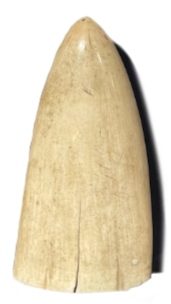
Sperm Whale Tooth, date unknown from Bridgehampton Museum Collection, (presently on view).
Beached Whale, February 25, 1944 black and white photograph From the photograph collection of Harry Squires. Photograph depicting a beached whale, responding police officer and local bystanders in 1944. (exhibition copy presently on view)
Sperm Whale Tooth, date unknown from the Bridgehampton Museum Collection This single tooth is banana shaped, with a slight curve; towards the sperm whale's body. It can reach up to eight inches in length and weigh over two pounds. Sperm whales have between 20-26 teeth-all located on their bottom jaw. (presently on view)
300th Anniversary Forefathers’ Whaleboat, 1956 photograph by Robert Tillotson original:8x10 in.(20.3x25.4cm) Reenactment photograph taken at Addison Topping's House across from Sagg Cemetery during the 300th Anniversary of the founding of Bridgehampton. The crew of a whaling boat: Howard Hand (Wainscott), Elisha Osborn (Wainscott), Gilbert P. Rogers (Sagg), Warren F. Topping (Sagg), Bob Tillotson (Sagg) (exhibition copy presently on view)

Surfcasting in Bridgehampton is a popular pastime, nearly year round. It is enjoyed by locals and visitors alike.

There are many tools and techniques used by seasoned fisherman. Nets, traps, harpoons, hooks, spears, and rods are all employed in order to catch the abundant sea life that our ocean and surrounding waterways have to offer.
We have a small selection of these implements currently on view in the Nathaniel Rogers House.

Making a living as a commercial fisherman on Long Island is not easy. Working the sea to survive is a hard life. We honor the men and women who continue this noble profession in our area and everywhere else.

bottom of page